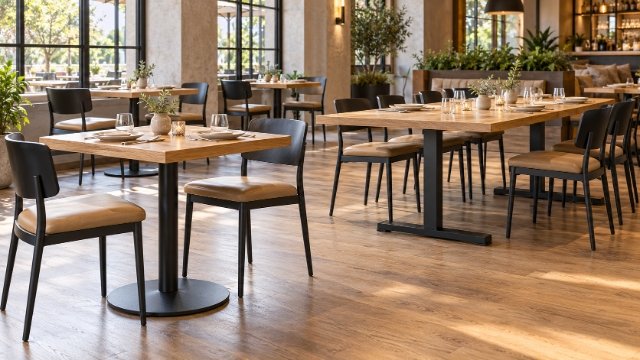
Restaurant layouts change throughout the day, but the furniture schedule still needs order. Standardizing table bases helps operators move from two-tops to larger group settings without turning every replacement order into a fresh specification job.
Standardization starts with table behavior
A useful base standard begins with how tables behave during service. Two-tops need compact support and easy chair clearance, while group tables need controlled edge leverage, repeatable height, and a reliable replacement path.
For buyers building a repeatable program, Fly Goat commercial table bases can support a standardization plan across cast iron, steel, T, round, cross, ornamental, and prong base families.
The goal is not to reduce every table to one model. The goal is to narrow the approved choices so staff, installers, and purchasing teams know which base belongs under each table format.
One platform can cover several table formats
A base platform works best when each model has a clear table-size role. OM223 fits smaller round tops, OM263 supports larger round tops, and OM324 moves into a 48 inch round table with a 4 inch round column.
That model separation gives purchasing teams a practical language for substitutions. If one location cannot use the planned top size, the team can move within the approved range instead of improvising a visually similar base.
The platform should also separate daily dining tables from occasional reconfiguration tables. A room that often joins tables for parties needs clearer paired-base rules than a room where each table stays in one position.
Two-tops and small dining tables
Small dining tables usually benefit from compact bases that leave chair movement open. The buyer should confirm the top shape, the intended seating count, and whether the room uses the same chair style across all small tables.
The standard should also define what counts as an acceptable small-table setup. A two-top near a wall, a freestanding two-top, and a small outdoor table may need different clearance checks even when the top size matches.
A consistent restaurant table base choices for operators document makes it easier to reorder the correct base instead of guessing from an old installation.
Group tables and joined layouts
Group tables need support that respects longer spans. OM222 is specified for paired use under 30 by 48, 30 by 60, and 30 by 72 inch tops, and cast iron double T bases can serve large formats such as 36 by 72, 36 by 96, and 60 inch round tops.
| Table format | Standardization question | Useful base evidence |
| Two-top | Can guests sit comfortably on all intended sides | Compact round or prong base matched to top size |
| Four-top | Can one model serve common square or round tops | Recommended table-size range by model |
| Long shared table | Does the edge need paired support | T base or double T base use case |
| Bar-height table | Is the taller version available for that model | Listed bar-height availability |
A standard does not have to flatten the design
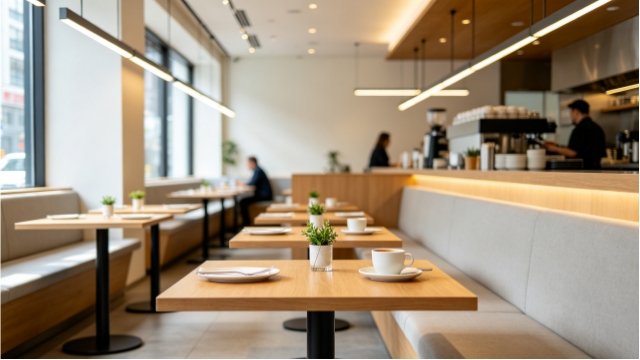
A good standard leaves room for venue character. Buyers can standardize the structural base family while varying table tops, chair finishes, and upholstery choices that fit each dining zone.
This is where restaurant tables and bases for flexible dining become a system rather than separate line items.
Fly Goat table bases include cast iron and steel options, while chairs are available in different colors and seat variations. The useful purchasing move is to approve combinations, not just individual products.
Combination approval matters because a base that works with one chair may feel awkward with another. Seat width, back angle, and leg position all change how much space guests feel under the same top.
Finish planning also belongs in the standard. Black, gray, chrome, upholstery, and wood-grain metal frames should be checked together so replacement orders keep the room coordinated without forcing every area to match exactly.
- Group base models by top size and dining zone.
- Record height, finish, top plate, and glide requirements.
- Keep paired-base rules visible for long rectangular tops.
- Use sample approval to confirm chair clearance and guest comfort.
Replacement planning protects the standard
Standardization only works when replacements follow the same logic. If a location swaps in a near-match base without checking top size, column height, or mounting plate, the standard slowly breaks down.
A simple replacement record can prevent that drift. The record should name the model, top size, finish, height, plate type, and any paired-base instruction so future orders repeat the approved setup.
Multi-location buyers should keep this record close to operations, not only purchasing. Managers often notice wobble, damaged finishes, or awkward seating first, and their notes help the next order correct the exact issue.
The record also makes reorder conversations shorter. Instead of describing a table from memory, the team can send the approved model, top size, finish, and pairing rule as a repeatable standard.
That discipline supports expansion because each new venue can start from a tested furniture logic. Local design choices remain possible, but the operational base decisions do not restart from zero.
Summary for multi-table programs
A restaurant can standardize table bases without making every table identical. The strongest program assigns each approved base to a clear table format, then keeps the model record close to purchasing and maintenance decisions.
If you are consolidating table bases across several dining formats, discuss a standard base schedule with us before the replenishment list is finalized.
FAQ (häufig gestellte Fragen)
What is a two top table
A two top table is a restaurant table planned for two guests, usually with a compact top and a base that should allow easy chair movement.
Can one table base work for several top sizes
One base can work for several top sizes only within the model’s recommended range and only when height, mounting, and clearance stay suitable.
Why standardize restaurant table bases
Standardization reduces specification errors, simplifies replacements, and helps multi-location buyers keep approved combinations consistent.
Do group tables need two bases
Many long rectangular group tables need paired support, especially when the model guidance calls for two bases under longer tops.
What belongs in a base schedule
A base schedule should include model, top size, height, finish, top plate, glide details, and any paired-base rule.